

Blog
How to Design LLM Fallbacks
A production-minded guide to designing fallback logic for LLM workloads, from failure classification to routing and user-impact measurement.
Start with failure modes
Fallback design should begin with the exact conditions that break a request: rate limits, timeouts, high latency, cost ceilings, provider incidents, or quality mismatches. If you do not know what counts as failure, you cannot design a meaningful recovery path.
A lot of teams build fallback logic too late. They start with one provider, assume the happy path will hold, and only react once a launch has already exposed cold starts, model outages, inconsistent quality, or runaway pricing. In practice, fallback design should be part of the first production architecture pass.
- Define failure classes
- Map primary and secondary providers
- Log fallback events
- Measure user impact
Separate technical failure from business failure
Not every failed request is a network error. Some failures are technical, such as timeouts, rate limits, or provider outages. Others are business failures, such as a model being too expensive for the current user tier, too slow for the page they are on, or too weak for the requested task quality.
This distinction matters because the fallback action should match the failure class. A timeout may justify switching providers immediately. A pricing breach may justify routing to a cheaper model. A quality mismatch may justify moving to a stronger model or asking the user to confirm a slower run.
- Technical failure: timeout, outage, invalid response, queue stall
- Business failure: budget breach, latency ceiling, quality floor miss
- Policy failure: blocked content, region restriction, compliance mismatch
Design a fallback ladder, not a binary backup
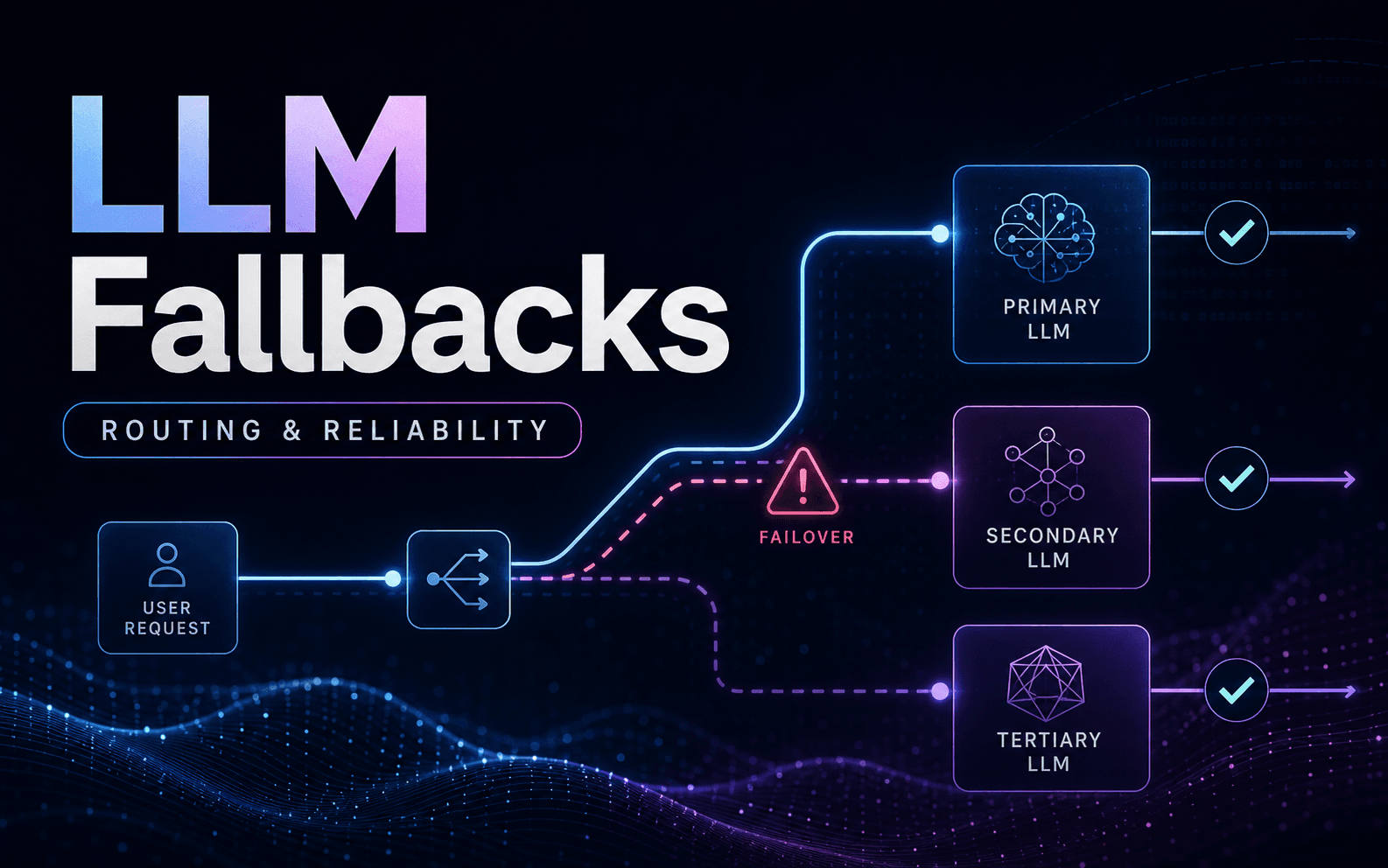
The most common mistake is treating fallback like a single secondary provider. Real products usually need a ladder instead of a backup switch. That means each request should have a preferred path, one or more lower-latency alternatives, one or more lower-cost alternatives, and a safe failure mode if nothing qualifies.
In other words, you are not asking 'what happens if provider A is down?' You are asking 'what is the next acceptable route if the current route violates one of my constraints?' That is a more useful way to think about multimodel production systems.
- Primary route for normal conditions
- Low-latency fallback for interactive surfaces
- Low-cost fallback for background or batch workloads
- High-quality fallback for premium or enterprise requests
- Safe failure response when no route qualifies
Route by workload, not by provider loyalty
Many teams implicitly overfit to one provider because they are already integrated there. That is an implementation convenience, not a routing strategy. In production, fallback design works best when the decision is tied to workload characteristics rather than loyalty to a vendor.
A chatbot, a support assistant, a report generator, and an agent workflow may all need different fallback rules even if they initially use the same base model. That is why fallback logic should sit above the provider layer, not inside a one-provider client.
Make fallback observable
If your system falls back silently and you never record it, you will eventually lose track of which routes are actually powering the product. Observability is not optional here. You need logs and metrics that tell you how often fallbacks happen, why they happen, and what the user impact looks like afterward.
The product team should be able to answer questions like: which surfaces trigger the most fallbacks, which providers fail most often, which models regularly miss latency targets, and whether fallback improves or harms the user experience.
- Track fallback count by route and failure type
- Log the chosen replacement model or provider
- Measure latency before and after fallback
- Correlate fallback behavior with user success or abandonment
Do not hide tradeoffs from the product layer
Good fallback design is partly an engineering problem and partly a product problem. If a fallback route is slower, lower quality, or more expensive, the product should know that. Otherwise, the UI and pricing logic will make promises the backend cannot consistently keep.
This is especially important for products with free versus paid tiers, human review states, or premium modes. A fallback that is acceptable for an internal draft may not be acceptable for a user-facing enterprise workflow.
A practical recommendation
Start by listing the top three ways an LLM request can fail in your product today. Then define the next acceptable route for each one. If you cannot name the next route or the rule that selects it, your fallback system is not designed yet.
The teams that handle LLM reliability best are rarely the ones with the single best model. They are the ones that know how to degrade gracefully when the ideal path stops being available.
- Classify failures first
- Map each class to a next acceptable route
- Measure fallback impact continuously
- Keep routing decisions aligned with real product constraints
Frequently asked questions
What is the first step in designing LLM fallbacks?
Start by defining failure classes clearly. Until you know what counts as failure in your product, fallback behavior stays vague and unreliable.
Should fallback mean switching to one backup model?
Usually no. The more robust pattern is a fallback ladder with different alternatives for latency, cost, and quality constraints.
Is fallback only an engineering concern?
No. Fallback changes product behavior, so pricing, UX promises, quality expectations, and review flows all need to understand it.
What should teams measure after adding fallback logic?
Track how often fallbacks happen, why they happen, which routes are chosen next, and whether those fallback events improve or harm user outcomes.